What it is
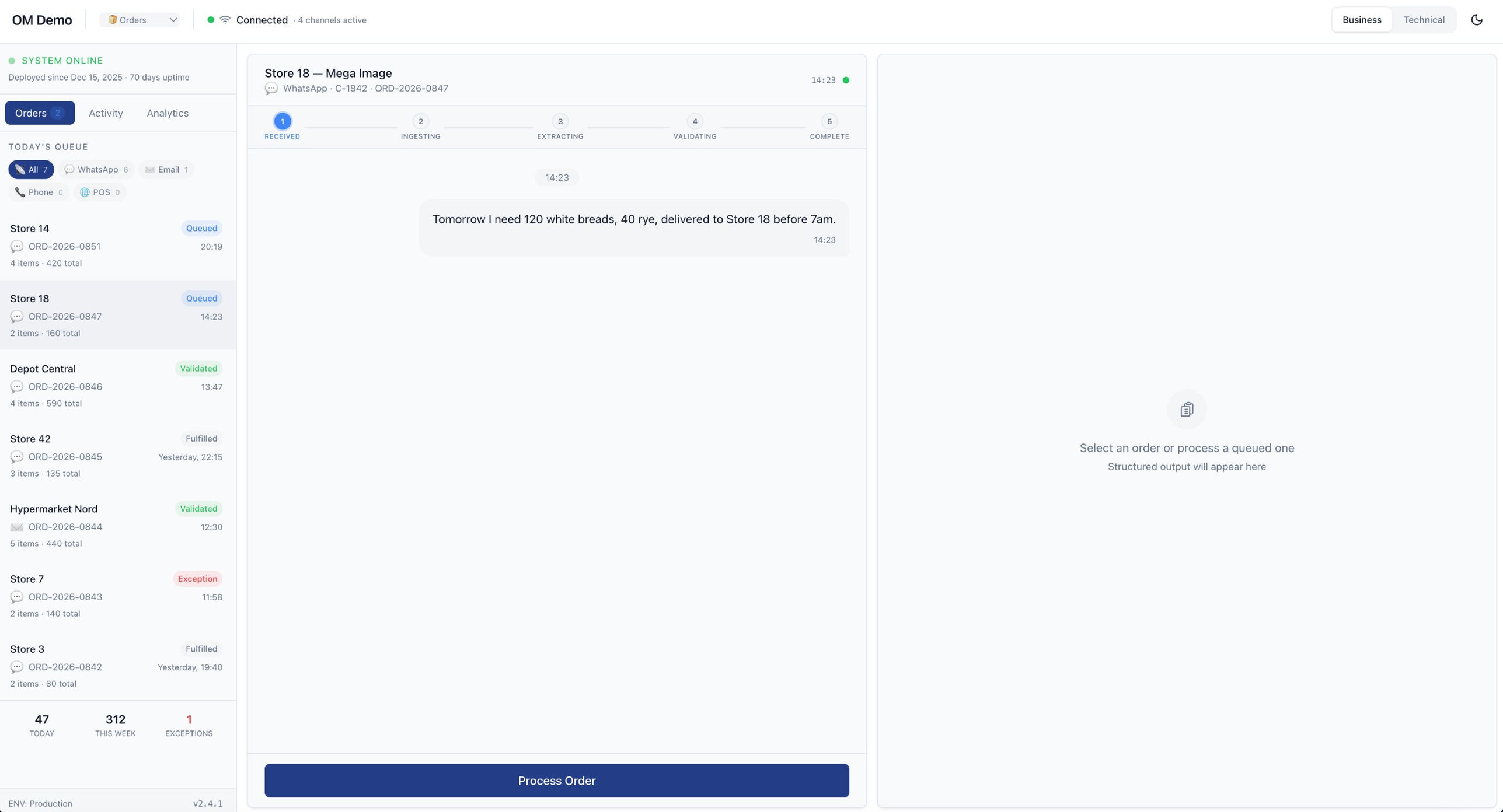
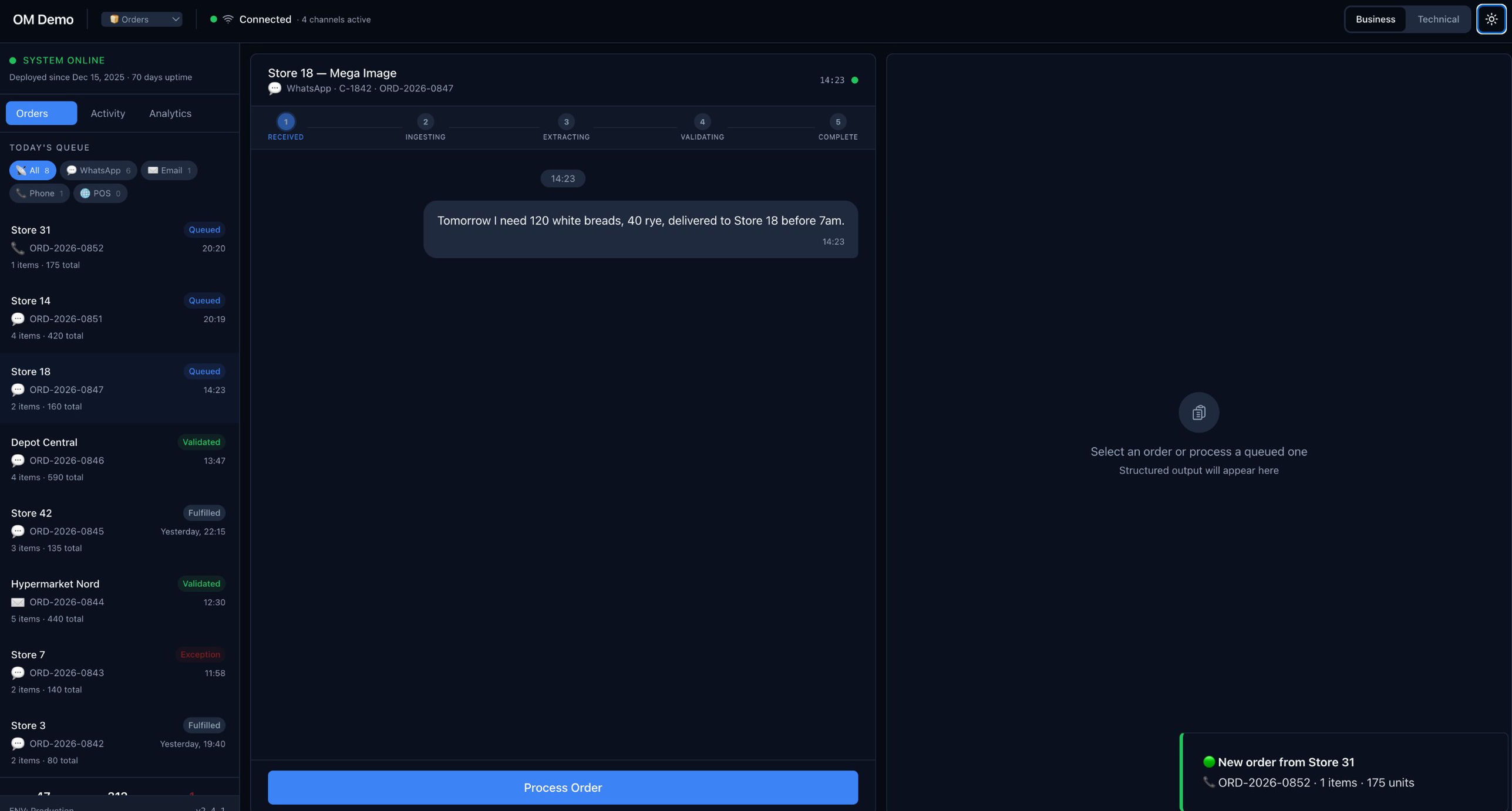
A prototype order-management agent that sits between the customer and the OMS. Orders don't arrive in one shape — they arrive as WhatsApp voice notes, emailed PDFs, phone-call transcripts, and POS events. The agent parses all of them into the same structured object: store, SKUs, quantities, delivery window, channel, customer ID, confidence. Retail operations feel this most, with order volume spread thin across every one of those channels at once.
From there the object moves through a five-stage pipeline visible in the top ribbon: Received → Ingesting → Extracting → Validating → Complete. At each stage it hits a different system — SKU availability, customer profile, past-order history, supply-chain availability — and either moves on or stops for review.
Human-in-the-loop, where it actually matters
Anything the agent flags — a SKU it doesn't recognise, a quantity outside the customer's usual band, a delivery window supply chain can't meet, a confidence score under threshold — escalates to a HITL review window on the right. The operator sees the raw message, the agent's structured interpretation, and the specific reason the agent paused. They approve, correct, or reject, and the decision trains the next pass.
The point is that HITL isn't bolted on at the end — it's one of the node types the process itself knows about, not a fallback for when AI fails.
Analytics the operator can actually defend
The analytics tab reports the numbers that justify the system's existence: throughput today and this week, confidence score distribution, total orders processed, savings made (vs. manual handling), exception count, and channel mix. These aren't vanity metrics — they're the numbers an ops lead would bring to the next budget conversation. It's proof of real usage and traction, not just a demo, which is what actually moves a budget conversation forward.
A small counter in the footer mirrors the live queue — 47 today, 312 this week, 1 exception — so the board is always visible without clicking into a report.
Stack
Built on Lovable — the prompt-driven app builder I use to go from idea to working prototype in an afternoon. Under the hood it comes out as a React + TypeScript single-page app, styled with Tailwind and shadcn/ui, with Recharts for the analytics and a few custom hooks to simulate the order and credit flows.